
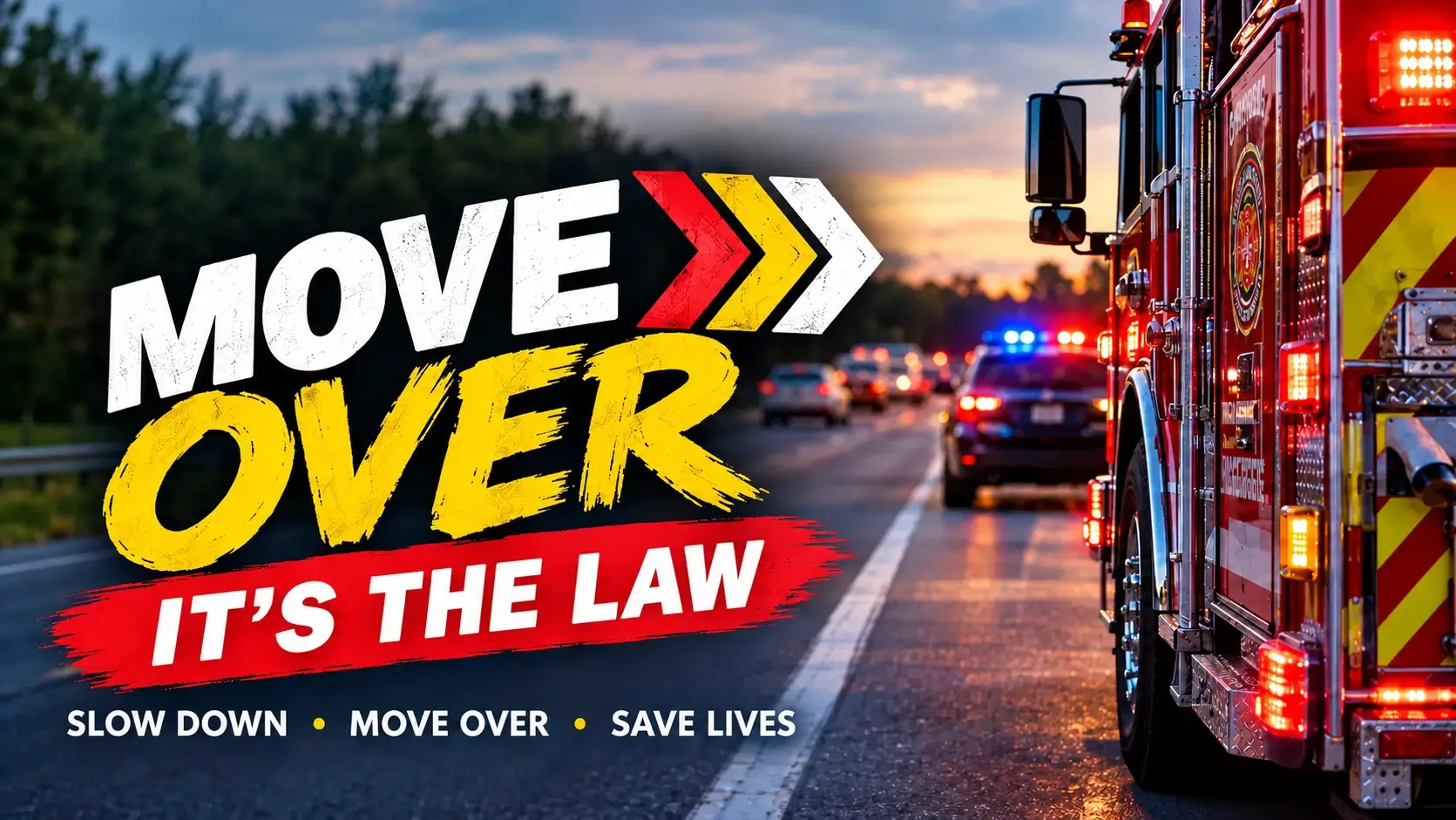
We all spend a lot of time behind the wheel. Daily commutes, school drop-offs, grocery runs, and weekend drives are so routine that it’s easy to go on autopilot. Our minds drift, the music gets turned up, a text pops up, and the kids in the back seat need something. Most of the time nothing happens, but when emergency vehicles are on the road or working a scene, those small distractions can matter a lot.
So here’s a friendly reminder from your neighbors at the fire department: when you see us, slow down, move over.
When We’re Coming Up Behind You
If an emergency vehicle approaches from behind with lights and sirens on, Pennsylvania law is clear: pull to the right and stop.
That sounds simple, but we see some surprising things out there:
- Drivers who don’t seem to notice the lights and sirens at all
- Drivers who pull over but keep rolling at the same speed
- Drivers who try to outrun us and stay out in front
- Drivers who stop right where they are, even in the middle of an intersection
None of these help. When we’re responding to a call, someone is waiting for us, and every second counts. A clear lane lets us get there faster and safer, for us and you. If we don’t get there, we’ve created an additional emergency and can’t help those who originally needed us.
A few quick tips:
- Stay calm. Check your mirrors, signal, and ease over to the right.
- Come to a full stop if it’s safe to do so, and stay put until we’ve passed.
- Watch for more than one. Fire trucks, ambulances, and police often travel in groups, so make sure the road is clear before pulling back out.
- Don’t slam on the brakes or swerve suddenly. Smooth and predictable is safer for all of us.
- At an intersection, don’t block it. Proceed through if you need to and then pull over, or follow the directions of the emergency crew.
When We’re Working a Scene
Pennsylvania also has a law, like most states, for when you approach an emergency scene on the road. Move over, away from the scene, and slow down. If you can’t safely move over, slow down anyway.
Why does this matter so much? Picture what a roadside scene looks like from our side. Crews are standing, kneeling, or walking just feet from moving traffic. They’re focused on a patient, a vehicle, or a hazard. They’re depending on every driver who passes to do the right thing.
Firefighters and EMS crews aren’t the only ones at risk. Police officers, tow truck operators, and other municipal and highway workers face the same danger every time they step onto the roadway. Every year we hear stories of responders being struck while doing their jobs. Those stories hit close to home for us, and they’ve reached our own county, too.
The Rubbernecking Problem
We understand the pull. Flashing lights and a busy scene naturally draw the eye. But slowing down to look, and especially pulling out a phone to take photos or video, makes things worse for everyone:
- It slows traffic and can cause secondary crashes.
- It pulls your attention away from the road at the worst possible moment.
- It puts responders and other drivers at greater risk.
Please keep your eyes forward and your phone down. And if you’re driving past a scene, resist the urge to speculate about what happened. Often we don’t know the full story ourselves, and the people involved deserve privacy and respect.
A Little Habit Check
Here are a few small things that make a big difference:
- Keep the volume reasonable. If you can’t hear a siren, you can’t react to it.
- Put the phone away. No texting, scrolling, or calling. Set up your music and navigation before you start moving.
- Check your mirrors often, not just before lane changes.
- Leave early. Rushing leads to tunnel vision. A few extra minutes in your schedule means a calmer drive.
- Talk to new drivers. If you have a teen who’s just getting their license, make sure they know exactly what to do when they see flashing lights.
It Comes Down to This
You want to get where you’re going safely. We want the same thing, and we want to get home to our families at the end of every call, just like you do.
Moving over costs you a few seconds. For us, it can mean the difference between going home and not. So the next time you see flashing lights in your mirror or on the side of the road, take a breath, ease over, slow down, and give us room to work.
Thank you for looking out for us while we look out for you. Stay safe out there, neighbors!
